LIBERO-10 · 10 long-horizon tasks
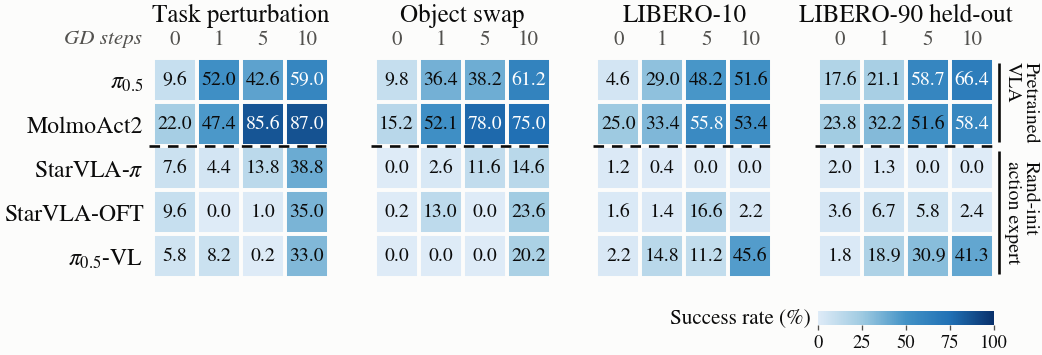
Success after 0, 1, 5, and 10 gradient steps on one demonstration
Each row is a FOSIL model trained on the same pretext behaviors from a different initialization. Each cell is the success rate after 0, 1, 5, or 10 gradient steps on one demonstration per task.
Robot pretraining
After one step, robot-pretrained models reach 29 to 33%; the rest stay under 15%
π0.5 and MolmoAct2 were pretrained on robot data; StarVLA-π, StarVLA-OFT, and π0.5-VL were not. The gap holds at five steps: 48% and 56% against at most 17%.
Same network
Re-initializing only π0.5's action expert halves its first-step gain
π0.5-VL is π0.5 with a freshly initialized action expert, trained on the same pretext behaviors. Its first step adds 13 points (2% to 15%) against 24 points for π0.5 (5% to 29%), and it needs all ten steps to reach 46%.
Why
One direction per weight matrix carries 87% of π0.5's improvement
Adaptation changes every weight matrix a little. We keep only the strongest direction of each change and test the policy again. For π0.5 that single direction keeps 87% of the improvement on LIBERO-10; for π0.5-VL it keeps 52%.
Our reading: robot pretraining has already built the direction a new task needs, so the demonstration adjusts it instead of constructing one from many smaller ones.
Update rank
π0.5-VL needs 16 to 64 directions to keep 90% of its improvement
Allowing k directions per matrix instead of one, π0.5 is near its full improvement from k = 1 on both suites (96% on LIBERO-Object). π0.5-VL climbs slowly, reaching about 90% at k = 16 on LIBERO-10 and k = 64 on LIBERO-Object.
Where
39% of the update's effect sits in the first six VLM layers
We give the unadapted π0.5 the update of a single block and measure how far it moves the policy toward the commanded object. The VLM carries 63% of the effect, and its layers 0 to 5 alone carry 39%. The action expert carries 10%, and no SigLIP layer more than 1.5%.
These are the layers where Swann et al. (2026) find salient, steerable features in π0.5.